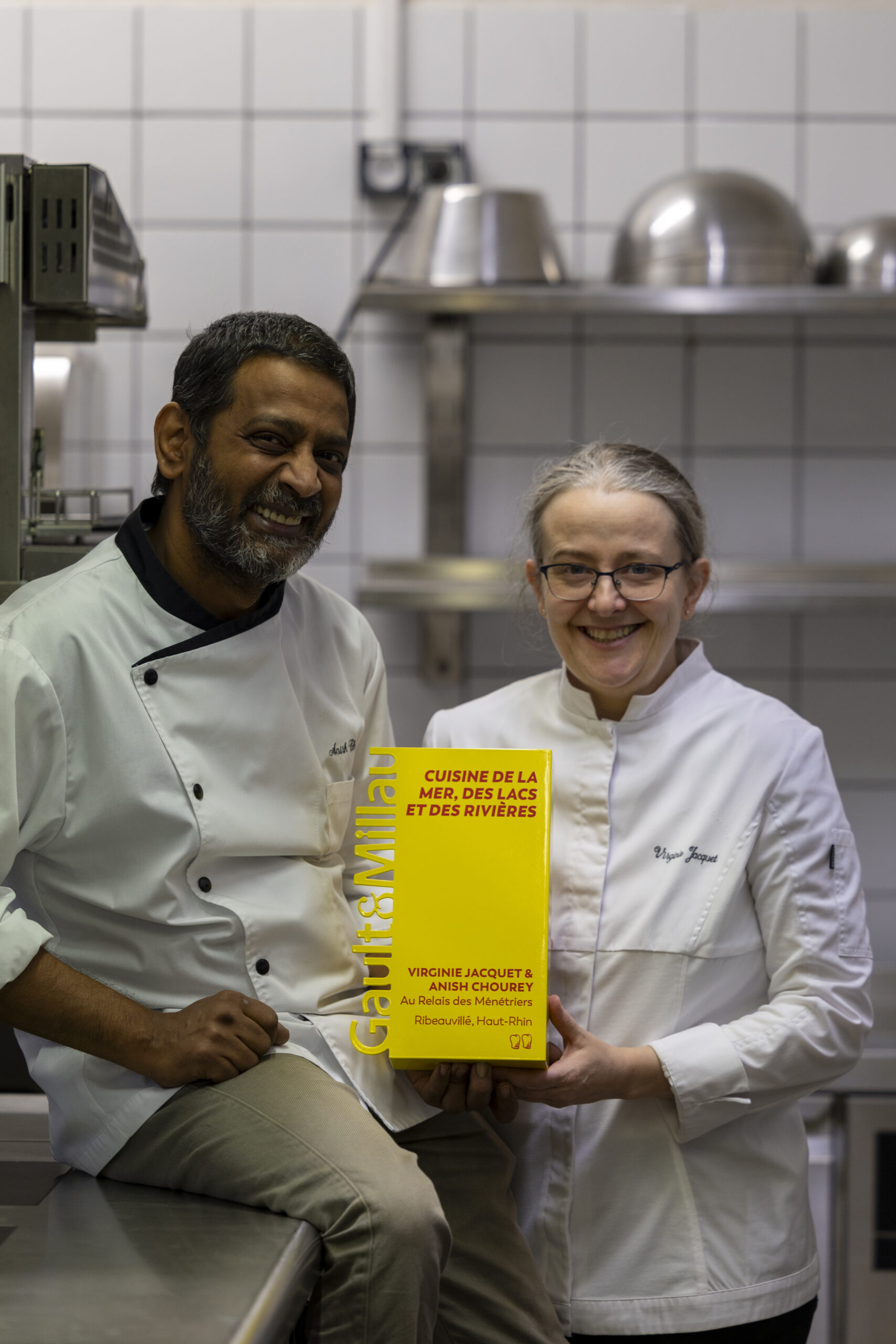


Post from 4 November 2026
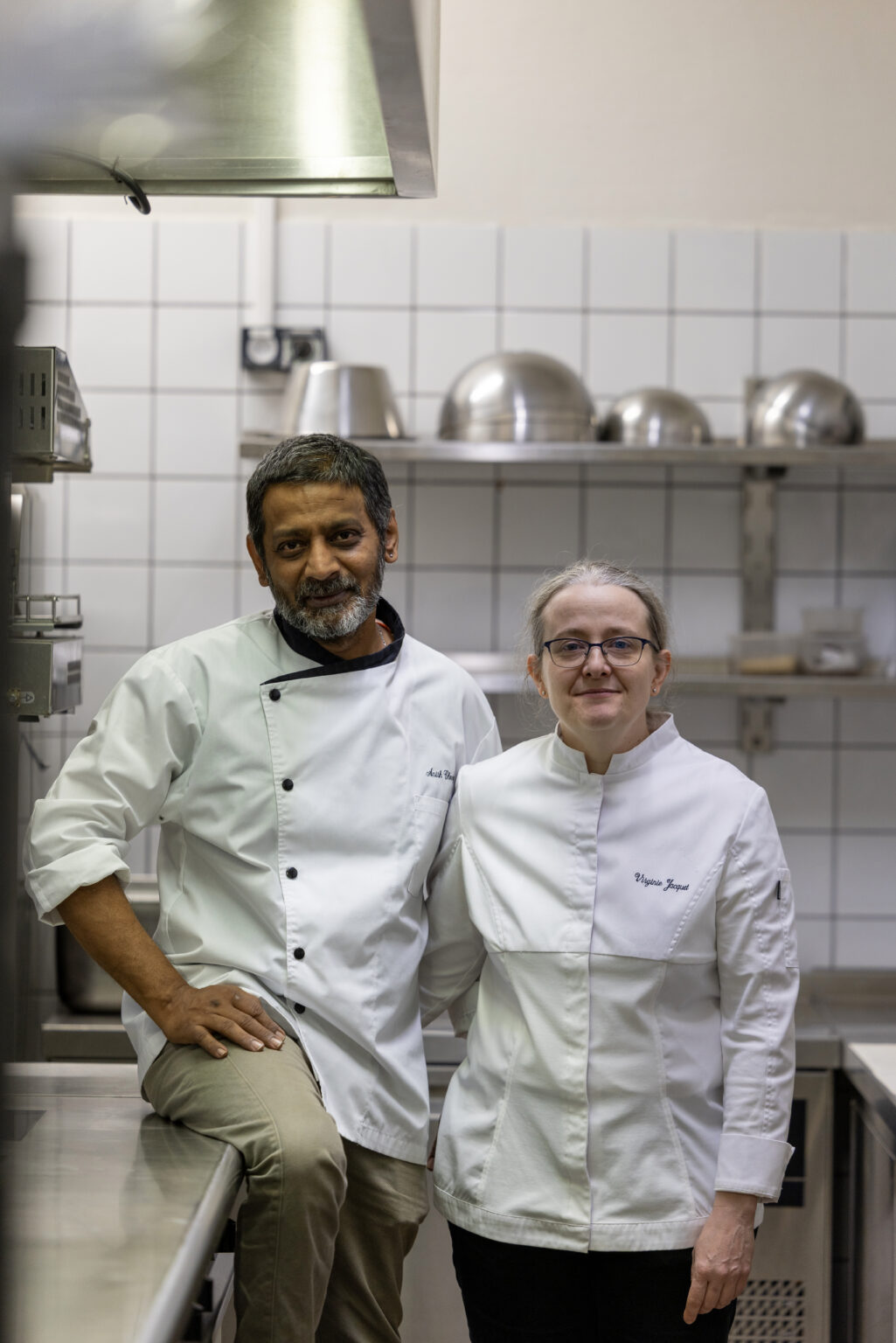
Virginie Jacquet and Anish Chourey
Twenty-two years in the business and a career as a team have given Virginie Jacquet and Anish Chourey one specific advantage: knowing exactly what they’re doing. At the Relais des Ménétriers since March 2026, they’re already moving forward with a certain confidence. Patrick and Claudine Serreau had run the restaurant for thirty-four years before them—long enough to establish a cuisine rooted in local ingredients and build a solid reputation. While preserving some of what made the place so special, the new owners have chosen to proceed step by step, winning over many regulars as well as a discerning clientele from all walks of life—Alsatian, German, Belgian, or Swiss—whom they particularly appreciate for their open-mindedness.
It took visiting about a hundred restaurants over six years before they fell under the spell of the Relais des Ménétriers, even before it was put on the market. They were looking for a great kitchen, space to express themselves, and a good location; they found a place that matched their vision. The project came together smoothly, driven by a network built on word of mouth—a true human chain.
Two main pillars underpin their work. On one hand, a partnership spanning more than two decades, which naturally divides the roles in the kitchen. Anish handles the fish and vegetables, which he elevates through color and presentation. Virginie handles meats and desserts, with a more floral sensibility. From the basics to the finishing touches, everything is decided and agreed upon together in true synergy.
On the other hand, they have a declared curiosity that goes against the grain of trends. In their view, globalization impoverishes the diversity of products by pushing everyone toward the same choices. They keep their distance from social media, a way of preserving their identity rather than letting it get lost in the background noise. Their priority remains focused on customer satisfaction. Their guiding principles: highlighting overlooked ingredients, diversifying the menu, and keeping prices reasonable for their customers—since less-in-demand products often cost less.
They therefore work with forgotten vegetables, little-known ingredients, and even fruits that are rare in Alsace: Chinese artichokes are turned into juice to enhance a dish, yellowtail replaces salmon in gravlax, tamarind is made into sorbet, and celery becomes a dessert.
The restaurant’s vegetarian menu adheres to the same high standards, always conceived as an original creation—particularly because Anish’s cuisine is built around vegetables and fish, stemming from a genuine passion for vegetarian food rather than as a constraint or a response to a trend.
Furthermore, Anish links this pursuit of quality to a broader conviction rooted in his heritage. He believes the body responds better to high-quality products—an idea closely aligned with Ayurvedic principles regarding the energetic quality of food. He extends this logic to a 50-kilometer radius around the restaurant as the ideal sourcing radius, based on the idea that a product grown in a given region possesses qualities suited to those who live there.
In this sense, the wine and beverage menu follows the same line of thinking: wines from the surrounding Alsace region—as far as Zellenberg—wines from France selected by a wine merchant in Ribeauvillé, the same goes for tea, and coffee from Bergheim. The chefs want to prioritize connections with local producers and merchants, build long-term relationships with them, and form a family, just like their own team at the restaurant.
Settling down permanently in Alsace—where the couple first met—was a natural choice.
She grew up in the countryside in the Ardennes, spending most of her weekends at her grandmother’s and uncle’s farm. The daughter of farmers, her mother—who loves to cook—instilled in her a passion for flavor and, above all, an eye for quality ingredients.
He, in India, would watch and sometimes help his father in the kitchen, where one could sense his father’s great joy in preparing family meals. During his BTS program, Anish gained a thorough grounding in Asian cuisines (Chinese, Indonesian, Indian) and learned—in theory only—European techniques. That’s why he left his homeland and came to France for an internship in Horbourg-Wihr with Pascal Bellicam. It was there, in 2003, that he met Virginie.
Since then, the two chefs have continued their journey together. They started at Bernard Loiseau’s restaurant in Saulieu in 2007, beginning at the very bottom of the ladder and working their way up step by step. Virginie rose from commis to fish section chef in two years, in a restaurant that taught her the simplicity and pure flavors that have come to define the “Loiseau style.”
Next came La Côte Saint-Jacques in Joigny, under Jean-Michel Lorain, followed by La Ferme Saint-Siméon in Honfleur, where they helped the restaurant earn its first star—a very different challenge, in their view, from maintaining a star that had already been earned.
They then headed south, first to Le Moulin de Mougins, then to L’Estivale in Nice, where Virginie took charge of the kitchen. In 2020, the couple returned to Saulieu. She became head chef at the restaurant Loiseau des Sens, with Anish as her sous-chef, before they made a stop at the Domaine du Roncemay, their final stop before Ribeauvillé. Eleven moves in twenty-two years, with each experience serving as a building block for their future project.
When asked about the identity of their culinary art, Anish humorously points out that they don’t cook Indian food! Their menu seeks to take diners on a journey beyond any specific country, blending what they’ve learned and experienced to the point of blurring the question of origin. While local Alsatian ingredients find their way into some of their dishes, iconic recipes serve more to nourish their memory of flavors—like a nostalgic reminder of the good old days.
The two chefs view their craft as a curiously fleeting art. A few minutes of preparation are all it takes for an equally quick tasting—one that is nonetheless capable of leaving a lasting impression, an indelible memory. Although they note that gastronomy has changed significantly—whereas people used to seek out good food and fine dining, today we eat less and less well, driven more by advertising than by taste—it remains vibrant and retains its capacity for renewal. Classics always make a comeback, as trends are fleeting, and Anish is convinced that French cuisine will soon return to its roots.
For Virginie and Anish, cooking is above all a calling. They describe themselves as natural-born cooks. They devote themselves to it wholeheartedly, viewing it less as a job than as a passion and a life’s work: “It’s what’s in our hearts!”
A Taste of Alsace
YOUR FAVORITE SEASON?
V: Summer spoils us with an abundance and variety of fruits that I love to work with.
A: I love the end of the year, especially fall. There’s such a wide variety of vegetables to choose from (squash, chestnuts, cabbage, leeks, parsnips, Jerusalem artichokes, etc.).
A PRODUCT WORTH (RE)DISCOVERING?
Crosne: it’s a tiny root vegetable that looks a bit like a caterpillar, and its flavor is somewhere between Jerusalem artichoke and sweet potato.
A LOCAL SPECIALTY?
To be precise, THE baeckeoffe, shared with our chef Pascal Bellicam (to whom we give a little shout-out as he retires this year), which marks the beginning of our career and the foundation of our cuisine.
A TASTE OF CHILDHOOD?
V: Chicken and rice, my mom’s signature dish.
A: Pulao (Indian pilaf). The first dish I ever cooked, with my father. A classic of Indian home cooking made with rice cooked in a pot with vegetables, lentils, and spices.
How to get there...